No Fees Unless We Win | Si Hablo Español | WhatsApp
A car crash can cause injuries that range from painful but temporary to permanent and life-altering — and most take time to reveal their full severity. Below are the injuries we see most often in Gulf Coast crashes, with their typical causes and warning signs.
Tens of Millions Recovered for LOCAL Accident Victims!
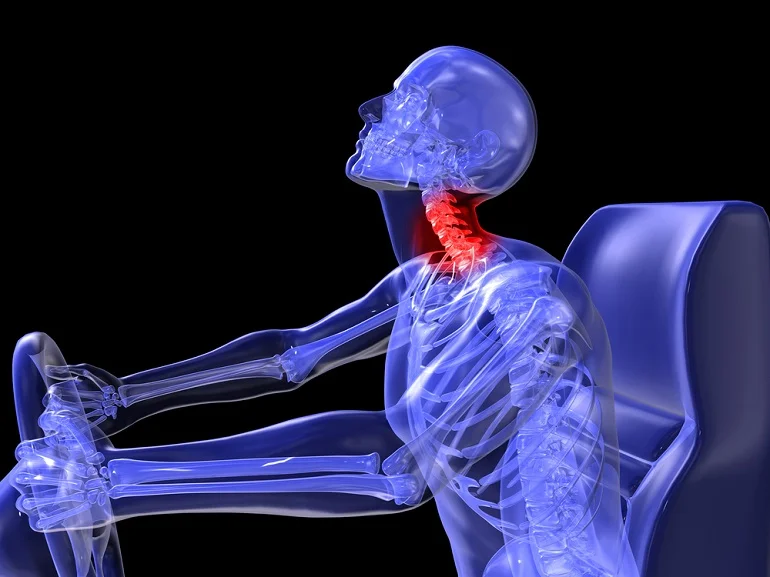
If you recognize any of the injuries below after a crash, see a doctor right away — some serious injuries hide their symptoms at first. Prompt medical care protects both your health and your claim. This page is general information, not medical or legal advice; for help understanding what your specific injury may mean for your case, the review at the bottom of this page is free and confidential.
The sudden back-and-forth snap of the head overstretches the muscles, ligaments, and discs of the cervical spine. Despite no visible bruising, the soft-tissue damage is real — and insurers routinely challenge it.
Most whiplash injuries result from a collision that includes sudden acceleration or deceleration — the rapid change in speed that snaps the head forward and then back. Many whiplash injuries occur when you’re involved in a rear-end automobile collision, where the force from behind throws the head and neck past their normal range of motion.
Video: “What Is Whiplash?” — peer-reviewed medical animation (Veritas Health, via YouTube).
Along with a complete health history and physical exam, your doctor may use imaging tests to evaluate the injury:
Treatment depends on your symptoms, age, overall health, and how severe the injury is. It may include:
Most people recover from whiplash within a few weeks to a few months, though some have persistent pain for several months or longer. Contact your healthcare provider if your symptoms don’t improve in the time frame your provider advised, if they get worse, or if you develop new symptoms.
Medical information adapted from Johns Hopkins Medicine. This is general information, not medical advice — always consult your own doctor.
The sudden force of a collision can overstretch or tear the muscles, tendons, and ligaments that support the lower back (lumbar spine). Unlike a fracture, a back strain or sprain doesn’t show on an X-ray — yet it can cause severe, lasting pain and limit everyday movement. Lower-back injuries are among the most common and most disabling crash injuries, and insurers routinely minimize them without strong, consistent medical documentation.
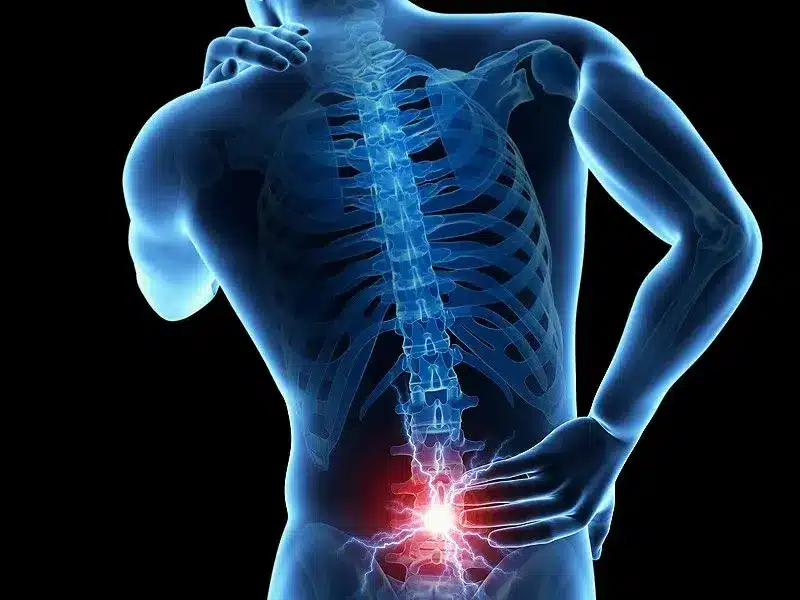
Lumbar strain affects the muscles and ligaments that support the lower spine.
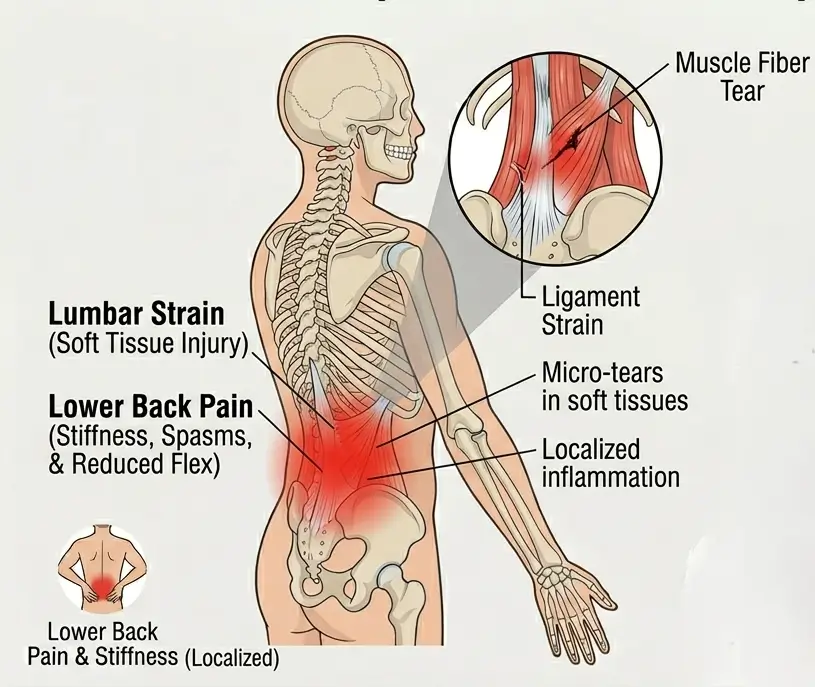
A lumbar strain is a soft-tissue injury — micro-tears and inflammation in the muscles and ligaments of the lower back.
The facet joints are the small, paired joints at the back of the spine that connect each vertebra to the ones above and below and control how the back bends and twists. In a collision — especially a rear-end impact — the sudden whipping motion can jam these joints together, overstretch or tear the surrounding capsule and ligaments, or inflame the joint lining (synovitis). Facet joint injury is one of the most common — and most overlooked — sources of lasting lower-back and neck pain after a crash, because it doesn’t appear on a standard X-ray and is easily mistaken for a simple strain.
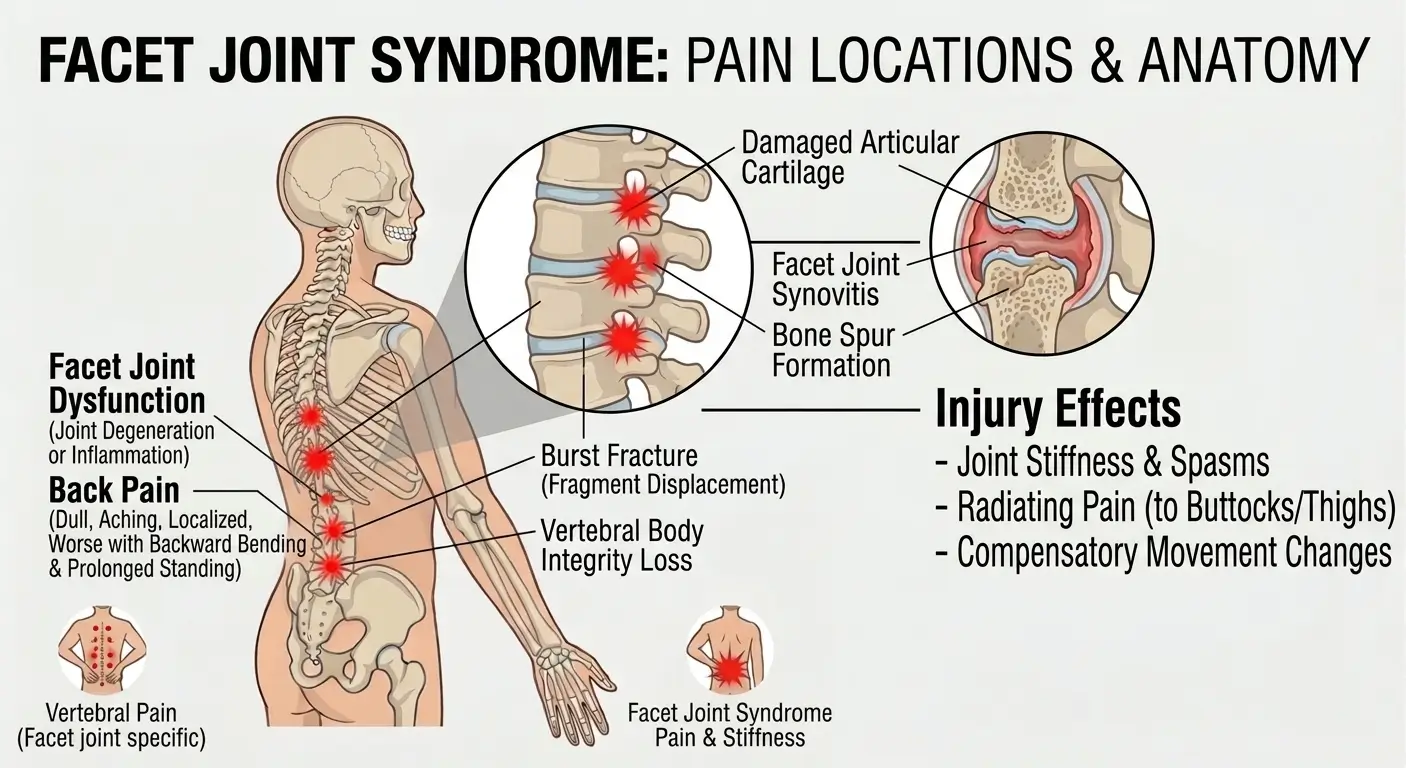
Facet joint syndrome — inflamed or damaged facet joints cause localized back pain that often radiates to the buttocks and thighs.
Treatment usually starts conservatively — rest, anti-inflammatory medication, and physical therapy to restore motion and strengthen the muscles that support the spine. When pain lingers, doctors may use targeted facet joint injections or a diagnostic medial branch block to confirm the joint is the source of the pain, sometimes followed by radiofrequency ablation to quiet the irritated nerves. Most people recover without surgery — but because facet joint pain can turn chronic, early diagnosis, consistent treatment, and thorough medical documentation for your claim all matter.
This is general information, not medical advice — always consult your own doctor.
Impact forces compress or twist the spinal column, pushing disc material out of its normal boundary. When that material presses on a nerve root, it causes radiating pain, numbness, or weakness — often into the arms or legs.
Between each pair of vertebrae sits a disc — a tough outer ring around a soft, gel-like center that cushions the spine. The sudden compressive and twisting forces of a collision can crack that outer ring and push the inner material out of place (a herniated or “slipped” disc). When the displaced material presses on a nearby nerve root or the spinal cord, it produces pain that radiates — down an arm when the injury is in the neck, or down a leg (sciatica) when it’s in the lower back. Rear-end and other high-impact crashes are frequent causes.
Video: herniated disc medical animation (Ghost Medical, via YouTube).
Diagnosis starts with a physical and neurological exam — checking reflexes, strength, sensation, and range of motion — followed by imaging:
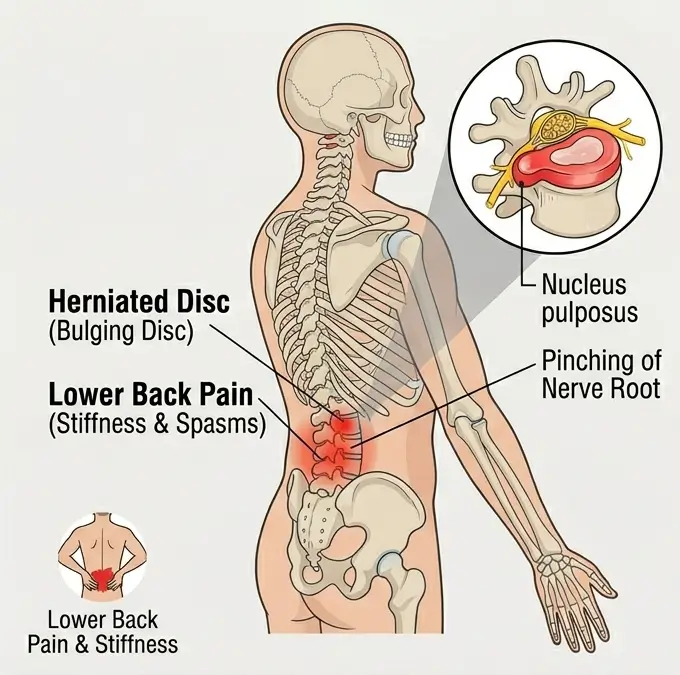
A herniated (bulging) disc — the soft center pushes out and presses on a nearby nerve root.
Most cases begin with conservative care:
When pain persists or there is significant nerve compression or weakness, surgery may be recommended — such as a microdiscectomy (removing the herniated portion), a laminectomy, or a spinal fusion or artificial disc replacement. Because these injuries can require surgery and ongoing care, they are among the higher-value claims.
Many people improve with conservative treatment over several weeks to a few months; recovery from surgery varies, and some are left with permanent restrictions or chronic pain. Seek emergency care for severe or rapidly worsening weakness, numbness in the groin or “saddle” area, or any loss of bladder or bowel control — these can signal cauda equina syndrome, a surgical emergency.
General information only — not medical advice. Always consult a qualified physician about a spine injury.
Even without a direct blow to the head, the violent acceleration/deceleration of a crash can slam the brain against the inside of the skull. Symptoms may not appear for days and are frequently dismissed by insurers as pre-existing.
Crashes injure the brain in two ways. The first is a direct blow — the head striking the steering wheel, window, dashboard, or even the airbag. The second needs no impact at all: the violent acceleration and deceleration of a collision makes the brain move, twist, and slam against the inside of the skull. That rotational force can stretch and tear the brain’s microscopic nerve fibers, and because the bruising is internal, symptoms often don’t appear for hours or days — which is exactly why insurers so often dispute these claims.
How a concussion affects the brain (Dr Wealz, via YouTube).
When the shearing forces of a high-speed crash tear nerve fibers (axons) throughout the brain, the result is a diffuse axonal injury — one of the most serious forms of traumatic brain injury. Because the damage is widespread and microscopic rather than a single bruise, DAI can cause prolonged loss of consciousness and lasting cognitive, physical, and behavioral changes, even when early scans look normal.
Diffuse axonal injury explained (Summit Medical Institute, via YouTube).
Beyond a neurological exam and cognitive testing (often scored on the Glasgow Coma Scale), doctors rely on imaging:
Importantly, a concussion or mild TBI — and even DAI — can be very real yet not show up clearly on standard imaging.
Treatment depends on severity:
Many concussions improve over weeks, but some people develop lasting post-concussion symptoms, and moderate-to-severe TBI or DAI can cause permanent changes in memory, mood, and physical ability. Seek emergency care for a worsening headache, repeated vomiting, seizures, confusion, slurred speech, weakness or numbness, or any loss of consciousness.
General information only — not medical advice. Always consult a qualified physician about a head injury.
High-impact collisions can fracture the wrist, ankle, ribs, femur, pelvis, vertebrae, and facial bones. Surgical hardware — plates, screws, and rods — dramatically extends recovery and can leave permanent limitations.
Not all breaks are alike — the fracture pattern affects treatment, recovery time, and the value of a claim:
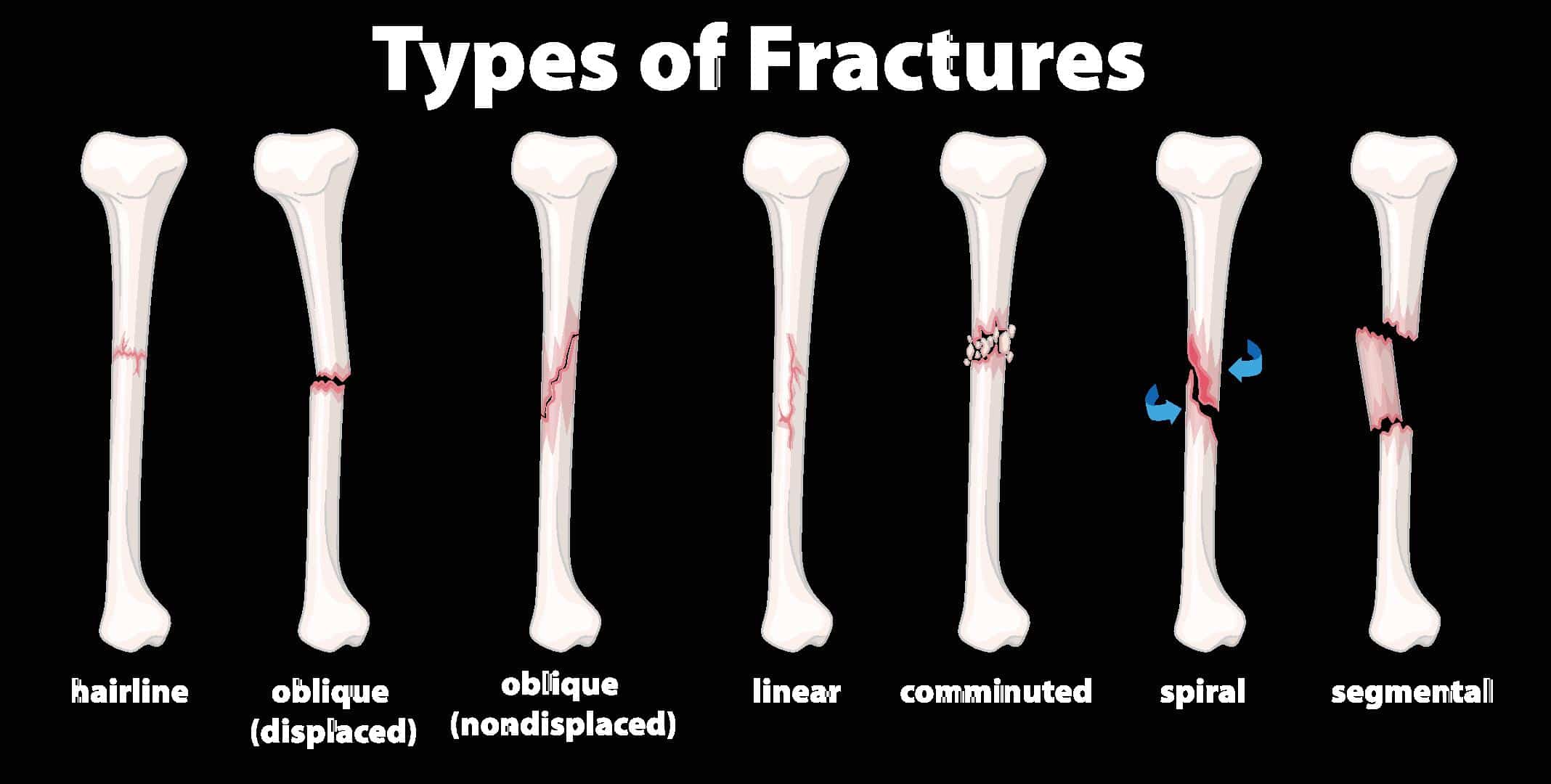
Common fracture patterns — the type of break affects treatment, recovery time, and the value of a claim.
A compression fracture happens when the sudden downward (axial) force of a collision crushes a vertebra in the spine until it collapses or wedges. In the most severe form — a burst fracture — the vertebra shatters and bone fragments can be driven toward the spinal cord. These injuries are common in head-on and rollover crashes and can cause severe, localized back pain, loss of height, a stooped posture, and, in serious cases, nerve damage. Because a vertebra can collapse gradually, the full severity is sometimes not obvious for days.
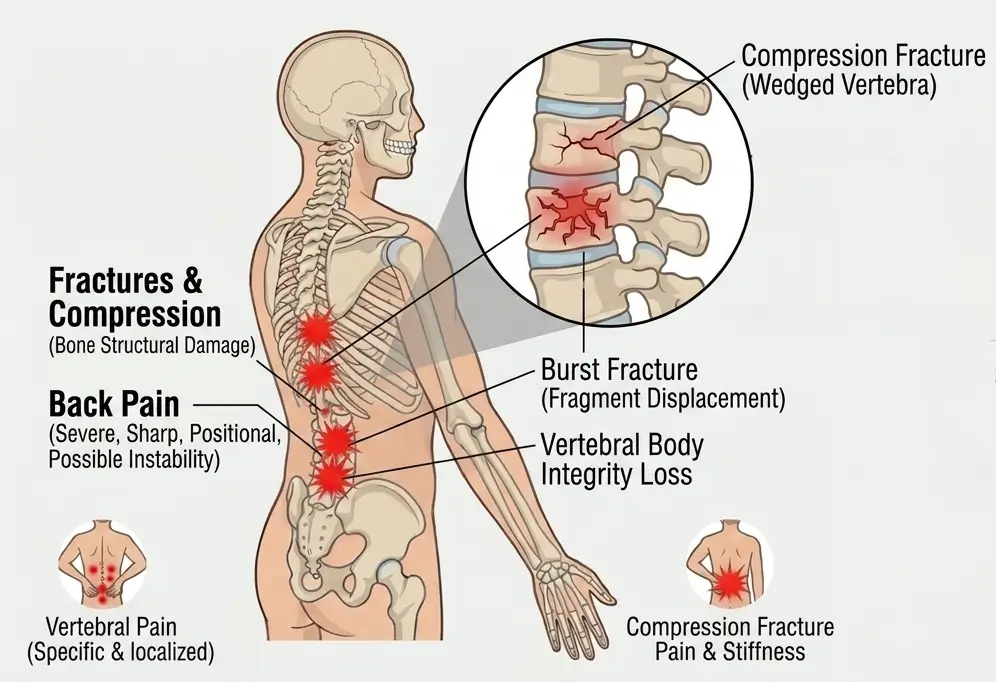
Compression and burst fractures of the spine — a vertebra crushed or shattered by crash forces.
Treatment ranges from bracing and pain management to procedures such as vertebroplasty, kyphoplasty, or spinal fusion for unstable fractures. Seek emergency care for back pain after a crash that comes with numbness, weakness, or any loss of bladder or bowel control.
General information only — not medical advice. Always consult a qualified physician about a fracture.
Dashboard impact and sudden twisting forces during a crash can rupture ligaments (ACL/PCL) and tear the meniscal cartilage that cushions the joint. These injuries often require arthroscopic surgery and months of rehabilitation.
In a crash the knees often slam into the dashboard or steering column while the leg twists violently — forces the joint was never built to absorb. The knee depends on four ligaments and two C-shaped cartilage cushions (the menisci), and a collision can damage any of them:
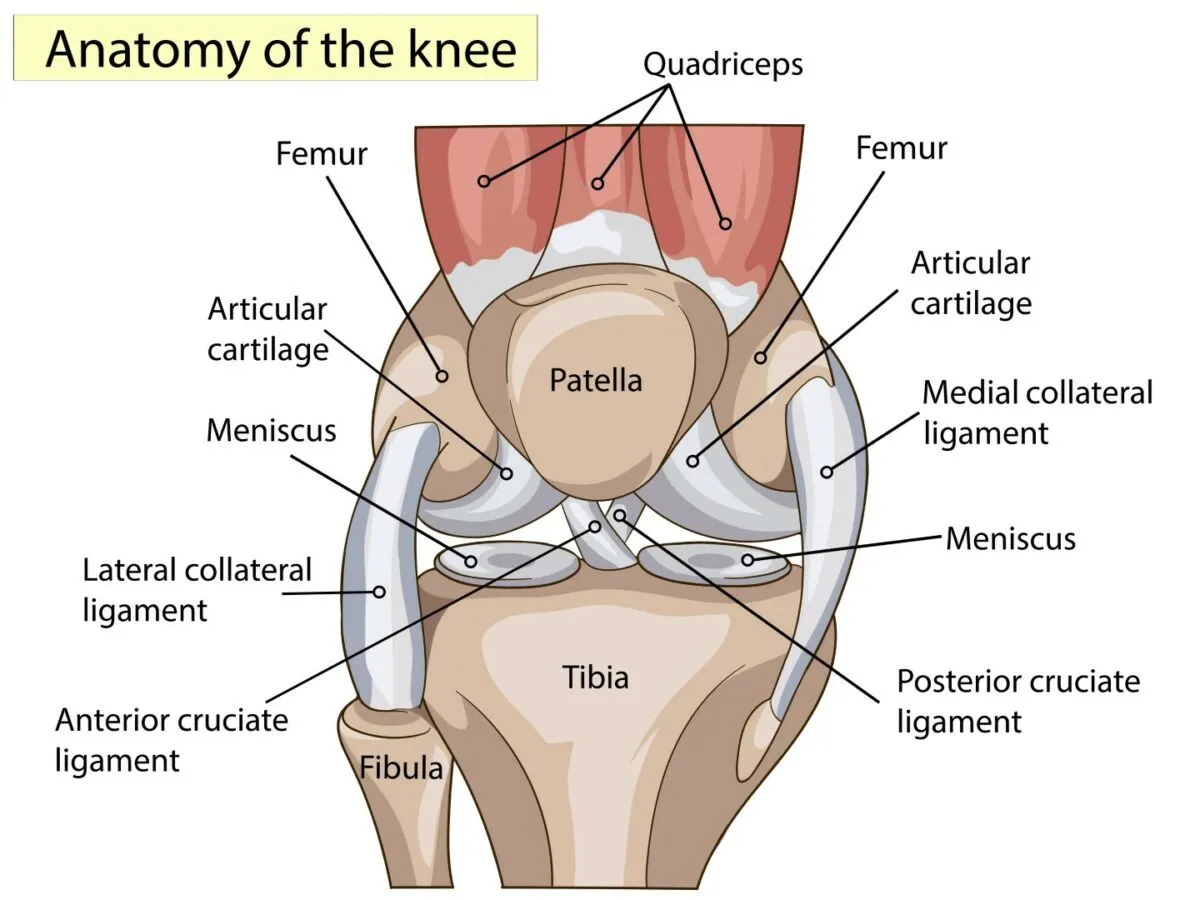
The knee’s ligaments (ACL, PCL, MCL, LCL) and meniscus cartilage — the structures most often injured in a crash.
Beyond a physical exam — checking stability, range of motion, and tenderness with maneuvers like the Lachman or drawer tests — imaging confirms the damage:
Treatment depends on which structures are damaged and how severely:
Mild sprains may settle in a few weeks, but ligament reconstructions and meniscus repairs often require several months of physical therapy before a return to normal activity, and serious injuries can leave lasting instability or arthritis. See a doctor promptly if the knee won’t bear weight, locks or gives way, swells rapidly, or looks deformed.
General information only — not medical advice. Always consult a qualified physician about a knee injury.
Gripping the steering wheel at impact, airbag force, or being thrown against the door commonly tears one or more of the four rotator cuff tendons. Partial tears may respond to therapy; full-thickness tears almost always require surgery.
In a crash, the rotator cuff — the group of four tendons that hold the shoulder joint together — is commonly hurt when an occupant braces against the steering wheel or dashboard, when the seatbelt locks across the upper body, or when a deploying airbag drives the shoulder backward. That sudden force can stretch the tendons past their limit or tear them — partially or all the way away from the top of the arm bone (the humeral head). Drivers most often tear the shoulder of the arm that was gripping the wheel at the moment of impact.
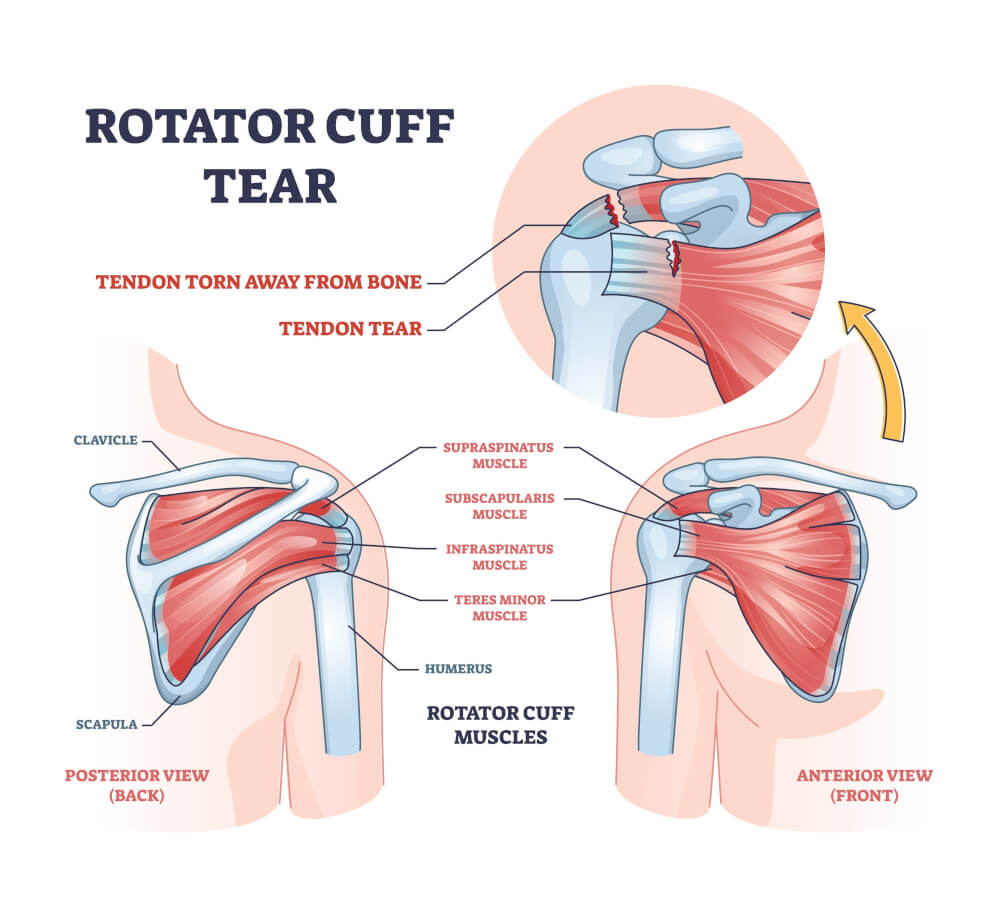
The four rotator cuff tendons and a tear pulling away from the bone.
Diagnosis usually starts with a physical exam to test the shoulder’s strength and range of motion, followed by imaging — an X-ray to rule out a fracture and an MRI or ultrasound to confirm the tear and measure how large it is. Partial tears are often managed without surgery using rest, anti-inflammatory medication, and physical therapy to rebuild strength. Full-thickness tears typically need arthroscopic surgery to reattach the tendon, followed by several months of rehabilitation. Because shoulder pain after a wreck is easy to dismiss as a simple strain, an untreated tear can quietly worsen over time — so a prompt evaluation matters.
Medical information adapted from OrthoInfo (American Academy of Orthopaedic Surgeons). This is general information, not medical advice — always consult your own doctor.
Sprains, strains, and contusions to muscles, tendons, and ligaments are the most frequently reported car accident injuries. Though invisible on X-rays, they cause significant pain and disability — and insurers aggressively downplay them without strong documentation.
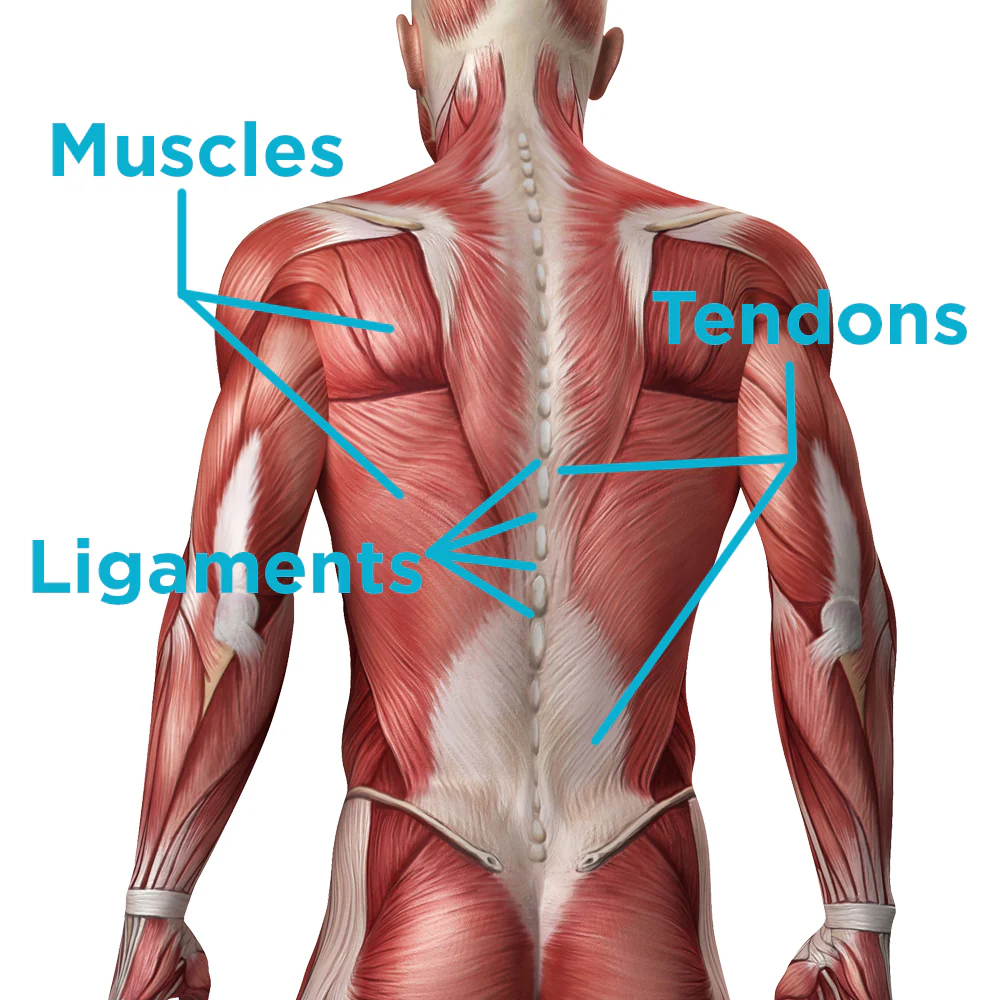
Soft-tissue injuries affect the muscles, tendons, and ligaments — damage that often doesn’t show on an X-ray.
High-speed collisions transfer enormous blunt force to the torso, potentially rupturing the liver, spleen, or kidneys — and causing aortic tears or internal bleeding. These injuries are especially dangerous because they may produce no immediate visible symptoms; hours can pass before pain or shock sets in.
In a crash, internal organ damage almost always comes from blunt-force trauma — the chest or abdomen striking the steering wheel, dashboard, or door, or being driven hard against the seatbelt as the body is thrown forward. The same seatbelt that saves your life can bruise or tear the bowel and abdominal wall (often called “seatbelt syndrome”), while the sudden deceleration of impact can shear the aorta or rupture solid organs such as the liver, spleen, and kidneys. Less often, broken glass or metal causes penetrating wounds. Because the bleeding is hidden inside the body, these injuries can become life-threatening before any outward sign appears — which is why prompt emergency evaluation after a serious collision is critical.
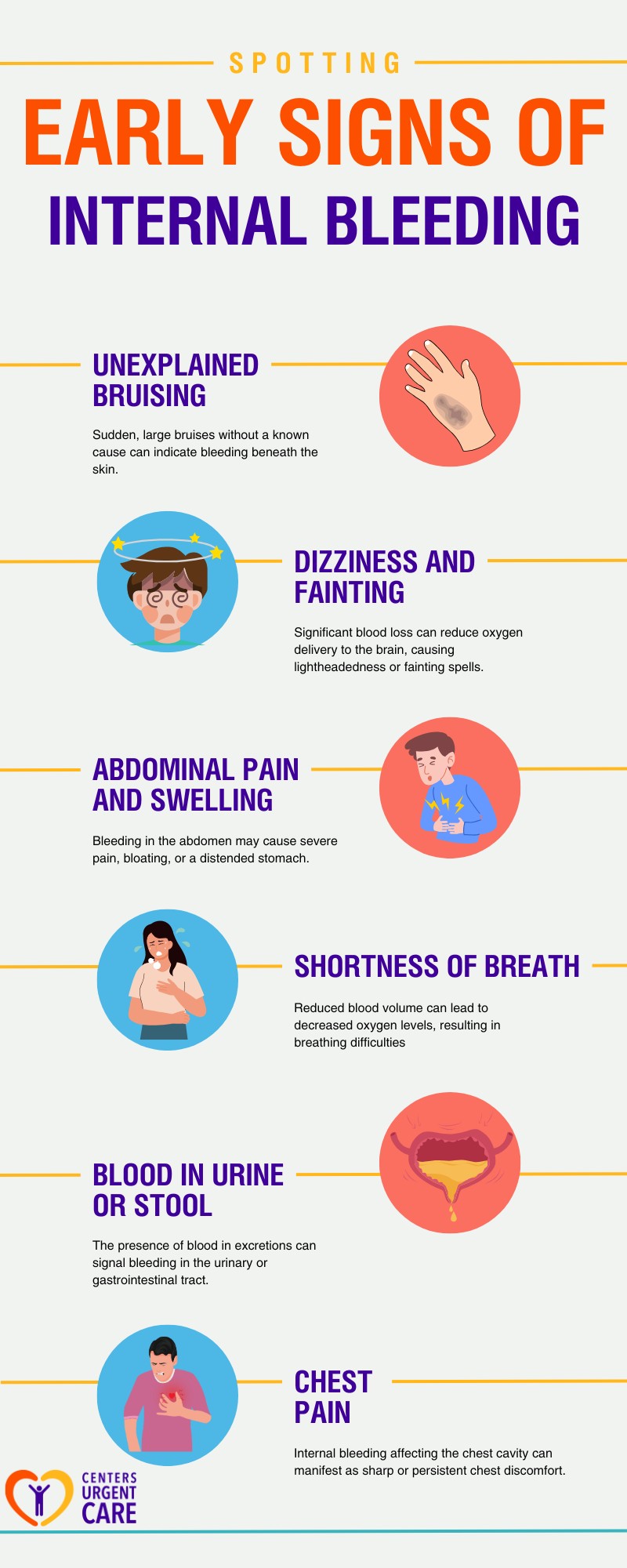
Early warning signs of internal bleeding — if any appear after a crash, seek emergency care right away.
Our track record speaks for itself. We’ve recovered tens of millions for injury victims across the Gulf Coast.
Prior results do not guarantee a similar outcome. Each case is unique and results depend on the specific facts and circumstances.
Fill out the form below and a member of our team will contact you within one business day. For urgent matters, call us directly 24/7.
Don't wait to get the legal help you deserve. Contact us now for a free, no-obligation consultation. We're available 24/7 to discuss your case.
No Fees Unless We Win | Free Consultation | Available 24/7